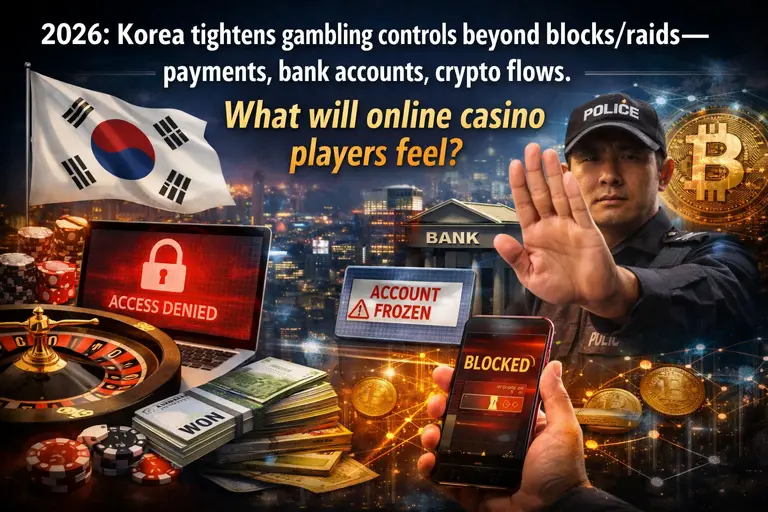
South Korea gambling regulation outlook for 2026: not “we’ll ban it,” but “we’ll make money flows inconvenient” — and break the system
Disclaimer: this is an informational piece to help you understand the logic of regulation, laws, and policy. It is not legal advice and not a call to engage in illegal activity. It also contains no instructions on bypassing blocks or restrictions.
If you look at the Korean market from the outside, it’s easy to get confused. Some people think, “People play anyway, so you can ban it all you want,” while others expect the opposite: “If there’s demand, then one day they’ll ‘loosen everything.’” But Korea starts from a different baseline. It’s a country that usually doesn’t make one sharp U-turn; from the very beginning it keeps the legal field extremely narrow, and everything else it makes progressively more inconvenient and more expensive.
That’s why the key to understanding 2026 isn’t the raid news itself. In headlines you most often see “uncovered,” “blocked,” “detained,” but the market is actually broken by quieter mechanisms. When those switch on, people feel it quickly: “You can get in, but the money won’t move.” “It seemed to go through — and now they demand verification.” That feeling is the “body” of regulation.
The baseline tone of regulation in Korea: “legal” is not a market, it’s an exception
In Korea, gambling by default is closer to a ban/punishment logic, while legality is structured as an exception. You can see this in the way the law is phrased. Based on the source cited in the original (rules/information as of the version effective on April 8, 2025), the Criminal Act (형법) Article 246 provides for a fine for gambling, but leaves an exception for cases that are at the “level of a one-off pastime.” In other words, the law tries to separate “once for leisure” from gambling marked by repeatability, scale, and habit.
From the same source: gambling is a fine of up to 10 million won, while “habitual/sustained gambling” is up to 3 years’ imprisonment or a fine of up to 20 million won. In addition, Article 247 creates a separate offense for opening a place/space for gambling for the purpose of making a profit. The penalty there is formulated as up to 5 years’ imprisonment or a fine of up to 30 million won.
Why does this combination matter? Because in Korea the approach often isn’t just “catch the operator and that’s it.” You can break up and prosecute the structure that allows gambling to function. That’s why providing a venue, bringing in people, promotion, operational support, and other “around-the-core” roles can also become a risk — a characteristic feature of Korean enforcement. The meaning retold in the original based on the Supreme Court (대법원) position also emphasizes that Article 247 is an independent crime, separate from the “ordinary” gambling offense, and that the “purpose of making a profit” criterion can be interpreted broadly.
The key point for 2026: not “blocks,” but “money flows become inconvenient”
People often think: “Just block the sites and that’s it.” But the moment the market truly starts to wobble is usually different. It’s when money moves more slowly, questions appear (“explain this”), and transactions can be stopped. In other words, what hits harder isn’t access to a website, but the everyday “felt reality” of payments: top-ups, accounts, withdrawals.
The original notes that on December 29, 2025, KoFIU (금융정보분석원, the Financial Intelligence Unit) launched a task force (TF) to improve AML (anti-money laundering). And the direction is quite directly linked to “touching the money routes.” It mentions: expanding the focus from large sums to smaller ranges, preparing mechanisms for the stablecoin ecosystem, and considering procedures such as suspending suspicious account activity during investigations. Changes like these feel far more “real” than the abstract phrase “tightening regulation.”
Crypto assets: from a “free corridor” to an object of tracking and reporting
Another important axis is crypto assets. They used to be described fairly often as a “grey corridor,” but by 2026 that view is weakening. In the logic of the news flow reflected in the original, cross-border operations increasingly fall under registration, reporting, and tracking.
The point isn’t simply that “regulation appears.” What matters more is: trails become denser, requests for proof increase, and the logic of “you can just split it up and slip through” works worse. So it’s more realistic to read 2026 not as “crypto will make it easier to get around things,” but as crypto channels moving deeper into AML/reporting/tracking.
“Grey formats” are hit first
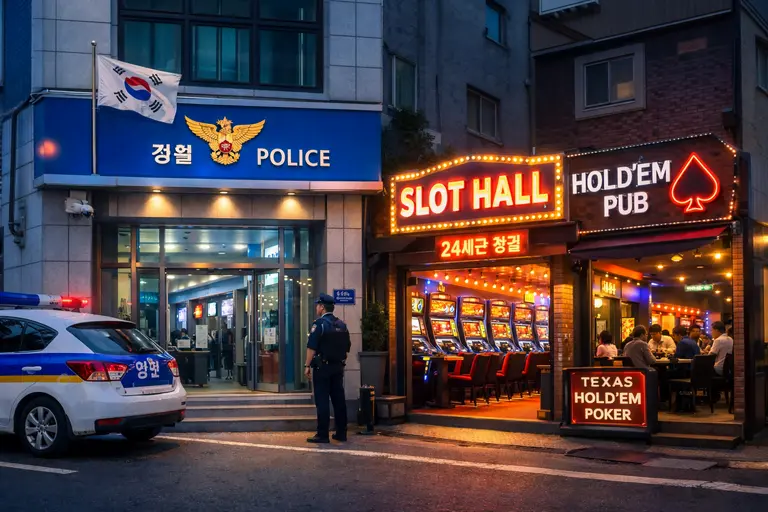
In Korean enforcement, one scene repeats often: from the outside it looks like “a game/culture/hobby,” but as soon as there’s exchange, prizes, or a revenue model inside, the interpretation shifts sharply. The original mentions Texas hold’em pubs as a typical example.
From the market side, you sometimes hear the idea “just change the form.” But Korea’s trajectory is more often the opposite: focus not on the form, but on the real operational substance. That’s why in 2026 “grey formats” remain a convenient target: it’s easier to justify publicly, and traces/evidence are easier to document. As a result, these formats find it harder to survive for long, costs rise, and public recruitment and promotion become noticeably riskier.
Even with legal casinos, “online liberalization” doesn’t follow automatically
Sometimes you hear the expectation: “If Korea has legal casinos, then one day they’ll ‘loosen’ online too.” But Korea’s legal construction is usually closer to “managing exceptions” than “expanding the market.” For example, Kangwon Land under a special law is often described as effectively the only casino that admits Korean citizens — and that “exception model” illustrates the regulatory philosophy well.
Instead of broad legalization — limiting things to manageable forms and pressuring everything else via money, promotion, and operational infrastructure. That’s why, in a 2026 outlook, “online liberalization” doesn’t look like an automatic end point, but rather a scenario where only a tightly managed zone might expand in a targeted way.
What changes will be “felt” in 2026
News headlines in 2026 may look the same: raids, detections, blocks. But the “felt” change is this: money moves more slowly, crypto channels leave traces more often, and “grey formats” start to wobble first. And promotion and recruitment — all that “publicness” — becomes more risky than before. So the environment shifts not toward “access problems,” but toward higher operational costs and risks.
Conclusion: gambling regulation in Korea in 2026 is not about “blocks”
Reducing illegal gambling to “zero” in Korea is practically difficult. But Korea often doesn’t set only that kind of goal. Instead, it acts more consistently: make the structure that enables it inconvenient, compress the scale, break the public layer, and leave trails that link to investigations — that logic looks more durable.
If you reduce the 2026 outlook to a single phrase, it would be:
“Not ‘we’ll ban the illegal market,’ but ‘we’ll make expensive the money, promotion, and spaces the illegal market runs on.’”
And that logic matches what’s reflected in the original: the provisions (형법 246·247), the retold meaning of the court position, and the KoFIU TF block dated December 29, 2025.
How Korea’s gambling market really works
In Korea, conversations about gambling are always loud. In the news and official statements, you constantly hear phrases like “stepped-up raids,” “mass detentions,” “eradicating the illegal market.” From the outside, it looks like regulation is harsh and there’s almost no choice. But if you look not at press releases but at the reality of the city, you get the feeling that the picture doesn’t line up one-to-one.
👉 Read more
FAQ
1) If it’s “one-off entertainment,” is it true there will be no penalty?
According to the source the original relies on, Article 246 of the Criminal Act (형법) sets a fine for gambling, but explicitly provides an exception for a case at the “level of a one-off pastime.” In practice, however, the outcome depends on specifics: frequency, time period, amounts, indications of systematic behavior, and other circumstances.
2) What does “risk not only for the operator” mean?
According to the original, Article 247 (형법) defines a separate offense: opening a place/space for gambling “for the purpose of making a profit.” The retold court position notes that this is an independent crime, separate from the general offense, and that the “purpose of making a profit” criterion can be interpreted broadly.
3) Why does AML become more important in 2026?
The original notes that on December 29, 2025, KoFIU officially launched a TF to improve AML (anti-money laundering) and began discussing changes. This can directly affect “money routes,” which is why in 2026 such measures are the most noticeable in day-to-day practice.
4) What’s the trend in cross-border crypto-asset regulation?
In the logic of the news flow reflected in the original, cross-border operations with crypto assets increasingly fall within a governance framework — registration and reporting. By 2026, this reads as a strengthening trend toward “capturing traces, reporting, and tracking.”
5) The forecast: “If there are legal casinos, does that mean online could be loosened too?”
Korea’s model of legality is more often interpreted as “managing exceptions,” not “expanding the market.” For example, Kangwon Land is commonly described as effectively the only casino that admits Korean citizens — under a special law. That’s why the direct linkage “legal offline exists → therefore online liberalization will happen” is not obvious; a more consistent scenario is that only tightly managed formats expand in a targeted way.