Illegal bookmakers in South Korea: sports betting outside the law
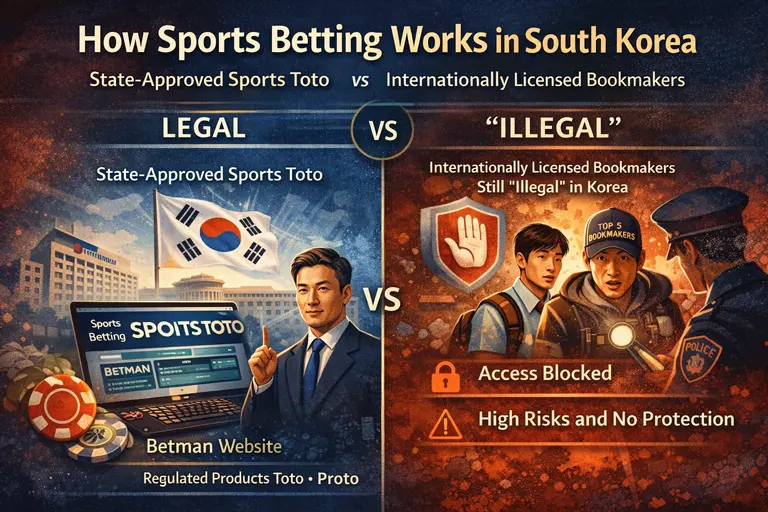
In South Korea, the label “illegal bookmaker” sounds simpler than the reality behind it. The reason is that Korea’s sports betting model is not a “market of dozens of privately licensed bookmakers,” as in some countries. Domestically, the legal model of sports betting is largely limited to the state-regulated Sports Toto framework (including Toto/Proto products), and everything else falls into the prohibited zone.
Because of this, one word—“illegal”—often mixes two different things: (1) large international operators that may be licensed in other jurisdictions but are illegal in Korea because they are not admitted into the domestic system; and (2) outright “black” sites with no clear name, address, or rules, surviving by rotating domains and disputed payouts. These are different risk levels—so below we separate them to make the picture clearer.
What “illegal bookmaker” means in South Korea
In the Korean context, an “illegal bookmaker” primarily means a service outside the state-approved framework. In other words, it is not part of the permitted formats, does not operate through the official system, and is not regulated as an “authorized bet” within the country. Hence the key takeaway: an international license ≠ legality in Korea. It may reflect status in another country, but it does not make the service permissible in the Republic of Korea.
The permitted model in Korea: how Sports Toto, Toto, and Proto work
The permitted segment of betting in Korea is structured as a “state framework”: Sports Toto operates under the oversight of relevant government / quasi-government bodies and is tied to a sports fund. In practice, this looks less like a free market of bookmakers and more like a single system with strict rules: a defined product set, limits, age and identity requirements, and controlled sales.
An important clarification to the common myth “Korea only has offline Toto outlets.” In fact, the legal product is sold both offline and via the official online channel Betman (the official distribution website). In the past, Betman registration access was more restricted, and since spring 2023 the sports betting operator has expanded online services for foreign residents (which was highlighted separately in news coverage).
This is the “permitted model”: a limited set of legal products under a strict rulebook, controlled by the state through sales and accounting infrastructure. Any “regular bookmakers” in the usual sense (private online bookmakers competing on odds and markets) do not fit Korea’s legal model for the domestic market.
Two categories of “illegal” bookmakers in Korea
To avoid confusion, it helps to split the illegal segment into two large groups.
- Category A — internationally licensed operators. These are brands that may have licenses in other countries, audits, history, and a large user base. But in Korea they remain “illegal” precisely because they are not admitted into the domestic framework.
- Category B — “faceless bookmakers” (the black segment). Sites/platforms with no clear owner, no address, no transparent license, and no solid rules or reputation. Here the user risk is highest: terms can change on the fly, checks can drag on indefinitely, payouts can turn into “negotiations,” and domains can disappear.
The problem with the media label is that these two groups are often presented as the same thing. But the difference is fundamental: in Category A the main risk is legal and infrastructural (ban, blocks, lack of protection within the ROK jurisdiction), while in Category B you also face the risk of outright fraud and “default irresponsibility.”
Why people move from the “permitted model” to the grey zone
Most often, there’s one core reason: demand for online formats and a wide selection of events doesn’t disappear, even if the legal framework is narrow. Then typical triggers kick in: some people want more market variety and formats; others want convenience and speed; some are irritated by restrictions and checks; and some simply don’t want to live in a “only this is allowed” mode.
Important: this is not a justification of the illegal segment. It’s an explanation of the mechanism. When access and formats are tightly constrained “from above,” part of the audience starts looking for alternatives—and that’s when the grey market expands, and with it the share of “black” players with no identity and no rules grows.
Risks outside the official framework: “two walls”
In Korea, a user outside the state framework often really ends up “between two walls.”
- From above — a ban, blocks, the risk of liability, and infrastructural restrictions.
- From below — especially in the black segment — no regulator and no protection mechanisms: a platform can drag out checks, change terms, dispute payouts, and act unilaterally.
So the honest conclusion is simple: the issue is not the slogan “legal/illegal,” but understanding the structure. Korea has a narrow permitted framework, and as long as demand remains, the grey zone will try to “serve” it. And wherever the grey zone grows, the black segment grows too—the most toxic for the user.
Conclusion
In South Korea, an “illegal bookmaker” is primarily a service outside the state mechanism for legal betting. But the term hides two different categories: internationally licensed operators (illegal in Korea due to prohibition/non-admission) and “anonymous” platforms with no address, license transparency, or accountability. They should not be assessed the same way.
And if we talk about why “crackdowns” don’t translate into the problem disappearing, the answer is usually structural: when the legal framework is narrow and demand is steady, the market moves online and into grey formats. Then the real fight is not for headline raid counts, but for how effectively the state and infrastructure can cut off money and operational routes—without allowing the black segment to become “the only alternative.”

1WIN in South Korea: full platform review — casino, sports betting, poker
A full review of the licensed 1WIN gaming platform for users in South Korea: casino, sports/esports and poker, bonuses and promos, deposits and withdrawals (KR bank transfer, KakaoPay, Toss, cards, crypto), pros/cons, reviews, and FAQ.
👉 Read more
FAQ
1) What is this material about?
It explains Korea’s sports betting model and why the “illegal bookmaker” label in the Republic of Korea often covers different types of platforms. We describe how the permitted framework works (Sports Toto/Betman), how internationally licensed operators differ from “anonymous” sites, and what risks exist in each scenario.
2) What is the legal sports betting model in South Korea?
Legal sports betting in Korea is organized through the state-regulated Sports Toto framework (Toto/Proto products). Sales run through offline outlets and the official online channel Betman. This is not a private bookmaker market, but a system with strict rules and a limited set of formats.
3) Why doesn’t an “international license” make a bookmaker legal in Korea?
Because legality inside Korea is determined by admission into the domestic system and compliance with Republic of Korea requirements. An operator may be licensed in another country and still be considered prohibited in Korea if it is not part of the state-approved framework.
4) How do the “two categories” of illegal bookmakers differ?
The first category is large international brands that may be legal in other jurisdictions, but are prohibited in Korea due to non-admission. The second is “black” platforms with no name/address/transparent license and no stable reputation: they may rotate domains, drag out checks, and act unilaterally.
5) Why do media often mix everything into one “illegal” label?
Because it’s easier to explain—and to sell—the position “only one model is allowed.” But for users, it’s a bad practice: legal “illegality” (a ban) and the risk of fraud are different things, and it’s important to separate them.
6) Why do people still go outside the state framework?
Because demand for online formats and a wide selection of events remains, while the permitted framework stays narrow and highly regulated. Part of the audience leaves due to restrictions, convenience, habit with online services, or a sense of “imposed choice.”
7) What does it mean that “the user is between two walls”?
On one side: a ban, blocks, and the risk of liability. On the other—especially in the black segment—no regulator and no protection mechanisms: the platform can change rules, delay checks, and dispute payouts. As a result, the risk often falls on the user.
8) Do you provide instructions for bypassing blocks, payments, or access?
No. This material explains market structure, regulation, and risks. There are no step-by-step instructions here for bypassing blocks, payments, or checks.
9) Where can I verify that Sports Toto and Betman are official channels?
Check the official websites: Sports Toto (sportstoto.co.kr) and Betman (betman.co.kr). You can also cross-check via Korean media coverage and official legal sources.