How gambling really works in Korea — and why “crackdowns” don’t deliver results
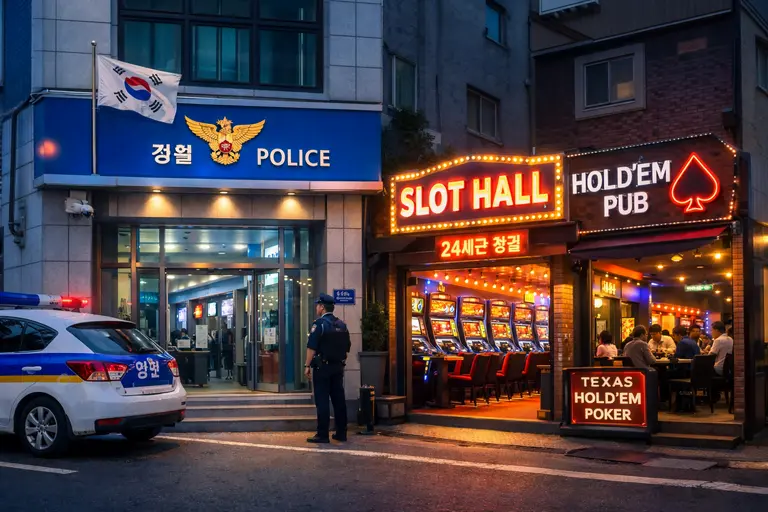
In Korea, conversations about gambling are always loud. In the news and official statements you keep hearing “stepped-up raids,” “mass detentions,” “eradicating the illegal market.” From the outside, it looks like regulation is harsh and there’s almost no choice. But if you look not at press releases, but at street-level reality, you get the feeling that this picture doesn’t match one-to-one.
The problem isn’t shrinking — if anything, it grows year after year. Demand hasn’t disappeared; it has simply changed form and moved online and into the grey zone. Slot-like gaming halls, venues disguised as “entertainment” or “bars,” hold’em bars, and other hybrid formats survive for a simple reason: they change the sign, relocate, rebuild operations — and keep going. That’s why people feel that the “official agenda” and the “industry on the ground” exist in parallel.
What frustrates people most isn’t the fact of a paper ban, but the sense that on the ground the atmosphere is often “everyone knows, but they pretend not to see.” Raids happen. But sometimes they look like one-off “events for reporting,” while a stable, systematic response that actually breaks the structure is less visible. That’s where the talk about “cover-ups” and “connections” comes from. When people watch the same scenes for years, they stop believing it’s just coincidence.
In this text, we’ll look not at slogans, but at reality: which formats truly survive, what the many “crackdown” measures have actually changed — and what they haven’t; why policy doesn’t work the way it’s intended; and how this affects users, businesses, and the city overall. Step by step.
Legal offline casinos: the rules are simple, but reality isn’t
Legal offline casinos in Korea are, on paper, fairly straightforward. Most licensed casinos operate on a “foreigners only” basis, and entry for Korean citizens is restricted. The well-known exception is Kangwon Land (강원랜드), often seen as effectively the only legal casino that admits locals. Formally, the conclusion is simple: if you want a casino, be a foreigner — or go to the single place where locals are allowed in.
But in reality, there’s almost always a shadow around the “foreigners only” model. From time to time, people talk about attempts not to follow the rules directly, but to “get in sideways” via status/identity. For example, you may hear stories about someone else’s personal details or club (membership) cards. And among the “cleaner-looking” approaches, people sometimes mention dual citizenship or other status changes — meaning an attempt to legally fall into a category that is allowed entry.
In practice, the ending is usually strict and simple: if a mismatch is discovered, it often results in immediate refusal of entry or removal. But this is where distrust appears. In industry talk and around it, one idea repeats constantly: requirements are applied harshly to some and more softly to others. The claim goes that an ordinary customer is “shut down” by the book, while a “high-roller” who spends a lot may find the venue noticeably more flexible. This is informal territory — but the fact that these stories persist matters: it shows the gap between the official narrative (“one rule for all”) and what people feel on the ground.
Hold’em bars: a legal “appearance” and an illegal “revenue model”
From the outside, a hold’em bar can look almost harmless: a bar atmosphere, tables, tournaments, a hobby club. On the sign, “poker” is presented as ordinary entertainment. And here’s the key: a card game by itself doesn’t have to be gambling. The line is crossed at the moment you attach economic meaning to it — stakes, profit, and converting the result into money or value via exchange/payout.
That’s why hold’em bars often stand on a “dual structure.” For a casual guest, it may look like a place where people play poker and drink. But for the “inner circle,” there can be a grey mechanism nearby where results are converted into value. Another typical detail: in these formats it’s rarely the case that any passerby can just walk in and immediately get “inside.” Often it works by invitation, through friends/recommendations, or there’s simple “filtering” at the door. This reduces random traffic and makes the internal layer less transparent to outsiders.
This is also what makes enforcement difficult: “from the outside” it can be described as “a bar + a game,” but to prove the illegal side you need to confirm money settlements, payouts/exchange, and the organizer’s involvement. Without evidence, it’s easy for an operator to say: “It’s just a game; there’s no money.” So these places usually fall apart not because of poker itself, but when investigators manage to document the behind-the-scenes structure: who collects money, who pays out, how exchange works, how profit is distributed.
Gaming halls/arcades: the key is “exchange and payouts”
Gaming halls and “arcades” are especially convenient for the grey zone because they can easily look like ordinary entertainment. Machines, coins, points, prizes — all of this can be legal leisure on its own. The problem begins where the game result stops being just “points” and starts functioning as money or its equivalent.
The mechanism is usually the same: conversion. Once points are exchanged for cash, for goods with an obvious market price, or for any form that is essentially a “payout,” it stops being “just entertainment.” So what matters most here isn’t what machine is standing there, but what happens after the game: who handles the exchange, how “value” is assessed, and how repeat customers are managed.
That’s why it’s hard to shut these places down “by the sign.” If exchange/payouts aren’t proven, the operator can always say: “We’re just a regular arcade.” But if the exchange is documented, and a clear controlling party appears, closure tends to move faster — there’s almost nothing left to argue about.
Why “crackdowns” don’t work well: incentives, demand, and the speed of adaptation
The problem isn’t that “nothing is being done.” The problem is that the response often ends with hitting the surface. A crackdown is pressure: blocks, inspections, raids. But if demand doesn’t disappear, it simply changes routes: it moves online, into semi-closed clubs, into forms that from the outside look “almost legal.”
The second reason is incentives. The harsher the ban, the more expensive access becomes — and the higher the margin for those who provide that access. As a result, a ban can sometimes make the market more “profitable” for those who adapted, rather than destroying it. The third reason is speed. A raid is an “event,” while adaptation is an everyday “process.” Changing signs, relocating, breaking into small points, closed channels — the market changes shape constantly. And sometimes that restructuring moves faster than the administrative machine can respond.
That’s how “two realities” appear. Reports and press releases show results, while on the street the feeling remains: “the underlying mechanism wasn’t broken.” In other words, what needs to be broken isn’t the signage — it’s the economics and infrastructure that allow these formats to survive.
Online casinos and sports betting: from “grey” to “black”
With online casinos and sports betting platforms, Korea is even tougher. Access control (for example, ISP-level blocks) and pressure on payments (when deposits/withdrawals become unstable) often don’t “kill” demand — they push it into a more dangerous zone. As a result, for large licensed global platforms, Korean traffic starts to look like a risk that doesn’t pay off, and many prefer to leave, restrict access, or distance themselves. Only a few remain.
Vacuum doesn’t last long. The fewer publicly verifiable and predictable players remain, the easier it is for the market to be filled not by a “grey zone,” but by a segment closer to the “black” market. Management becomes less transparent, marketing more aggressive, withdrawal disputes more frequent, and user-protection mechanisms weaker.
For the user, two groups of risks remain: blocks and liability — or “rules without rules.” In the “official” reality, access is cut, payments wobble, and involvement in the illegal segment brings the risk of liability — fines or even prison terms. In the “black” reality, the other extreme applies: unlicensed, unsupervised casinos and bookmakers can change terms at any moment, delay checks, freeze withdrawals, or block an account after a big win.
The worst part is that in both scenarios the user ends up alone with the risk. From above there’s a ban and possible liability; from below there are no mechanisms that restrain platform abuse. That’s why the market feels like “total defenselessness”: above — blocks and liability; below — an unregulated black segment; and between them — a user without guarantees.
Conclusion: between TV and reality — what’s really happening
On TV you hear, again and again, “we stepped up raids” and “we’re eradicating it.” But in reality you see a different story: the market doesn’t disappear — it migrates and changes form; formats that look legal on the outside survive in the grey zone. Hold’em bars and gaming halls are separated not by “appearance,” but by the “money contour” (exchange/payouts): the blurrier it is, the easier raids look like one-off episodes.
Online is even more straightforward. Blocks and payment pressure didn’t remove demand — they pushed out verifiable players and made the market darker, closer to “black.” In the end there are two sets of risks: from above — blocks and liability; from below — arbitrary rules of platforms without licenses or oversight. The user is squeezed between them and carries the risk personally.
So the conclusion is simple: “crackdowns” do exist, but they haven’t worked as a mechanism to make the market disappear. Instead, the market has become more fragmented, more closed, and more opaque. TV shows “a picture of success,” while reality leaves “a structural outcome.” And the main question is not how many raids were conducted, but how deeply authorities can cut off the money flows that support the system — and whether any mechanisms of user protection can exist at all under these conditions.
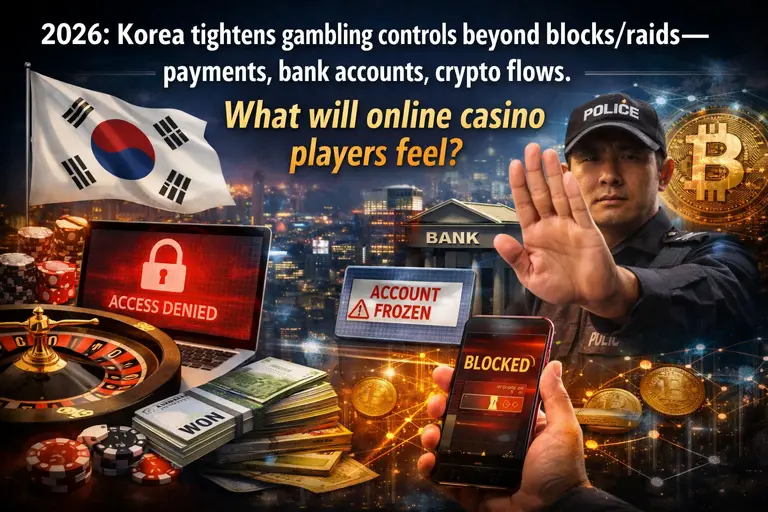
South Korea gambling regulation outlook for 2026
In 2026, Korea’s gambling agenda is less about “softening” and certainly not about “legalizing online casinos,” and more about tighter control. Website blocks may become more precise, and raids and inspections more regular. And if enforcement moves deeper into money flows (payments, accounts, crypto assets), the market will feel the change not at the level of “access,” but at the level of “money” — where the entire operating scheme breaks.
👉 Read more
FAQ (frequently asked questions)
What is this material about?
It’s about the “reality” of Korea’s gambling market. We break down the structure and risks: legal offline casinos, offline grey-zone formats (hold’em bars, gaming halls), and the online segment (casinos and sports betting). And we explain why “crackdowns” often don’t translate into a noticeable result.
Is casino gambling legal in Korea?
Offline casinos in Korea are legal. But most operate on a “foreigners only” basis, and the place where Korean citizens are effectively allowed entry is typically cited as a single one (Kangwon Land).
Why doesn’t the problem shrink under a strict “ban”?
If demand doesn’t disappear, the market changes form. It moves online or spreads across grey-zone formats that look legal from the outside — and therefore become less visible.
What is a hold’em bar, and why is it controversial?
A hold’em bar is a “bar + poker” format. The issue isn’t poker as a game, but the moment the game is tied to a money contour (exchange, payouts, revenue). From the outside it can look like entertainment, but inside a different economy can operate.
Why do people say it’s hard to just walk in from the street?
Some formats operate semi-closed: through acquaintances, recommendations, and invitations, sometimes with a simple “filter” at the entrance. This reduces random visits and lowers outward visibility.
Why are gaming halls/arcades hard to distinguish?
Because on the outside they can look like ordinary entertainment. The key isn’t the machine, but “what happens after”: if points/results are converted into cash or value (exchange, payouts), the nature of the venue changes.
Why don’t raids and blocks solve the problem?
Because the market adapts quickly: it changes signs, relocates, fragments into small points, and shifts into closed channels. If a raid is an “event,” adaptation is a daily “process.”
Why are online casinos and sports betting called the “black market” segment?
Because in places without licensing and oversight, user-protection mechanisms are weaker. Rules can be changed unilaterally, checks can be delayed, and withdrawal disputes or account blocks can be handled without transparent procedures.
What does it mean that “the user is squeezed between two walls”?
One “wall” is government blocks, bans, and the risk of liability. The other is the arbitrary rules of unregulated platforms (the black market). In both scenarios, the risk often falls on the user, without sufficient protective mechanisms.
Does this site provide instructions to bypass blocks or “schemes”?
No. There are no step-by-step instructions about VPNs, DNS, or bypassing payment restrictions. The goal is not to encourage use, but to explain structure and risks.
How do you separate facts from rumors?
We look at repeatability (does the same pattern recur again and again), diversity of sources, and the logic of the mechanism. Where there isn’t enough basis, we don’t state things categorically — we separate observation from hypothesis.
Can I send a story or suggest a topic?
Yes. The more clearly you indicate timing, context, the sequence of events, and any verification (screenshots, records, etc.), the easier it is to analyze. There’s no need to send personal data — and it’s better not to send it at all.